
7 Reasons Training Providers Lose Sales And How CPD Accreditation Can Help Address Every One

Training providers can lose sales not because of poor products, but because of a credibility gap. Professional buyers tend to research independently before contacting a provider and often need visible signals of quality, clear messaging, and consistent market presence before committing. CPD accreditation is one way to address each of these seven common failure points, helping to convert buyer hesitation into bookings.
Who this is for: CPD-accredited training providers, course developers, and learning and development professionals
Time to read: 10 minutes
Published by: CPD Standards Office | 08 May 2026
If qualified buyers keep going quiet, the problem often isn’t your price, your product, or your pitch. It’s a credibility gap that forms before you ever speak to them. Here’s what may be happening, and how to address it.
You’ve built the curriculum. You’ve refined the delivery. You’ve set a competitive price and invested in marketing. Yet qualified prospects still hesitate, they browse, enquire, and then go quiet.
The instinctive reaction is to cut the price, increase ad spend, or follow up more aggressively. But these tactics rarely address the underlying issue. Below are seven reasons buyers commonly don’t convert, and how CPD accreditation can help address each one.
1. Buyers can’t find credibility signals before they contact you

Research across B2B markets consistently suggests that professional buyers tend to evaluate providers independently before making contact.
Recent industry benchmarks indicate declining organic traffic, rising paid acquisition costs, and reduced performance across traditional lead generation channels, highlighting the increasing importance of credibility and trust signals for training providers seeking sustainable growth.
Source: LinkedIn Marketing Research and Insights
If they land on your website and find no independent signals of quality, no accreditation status, no third-party recognition, no testimonials, their hesitation is a rational response, not a sales process failure.
CPD Standards Office provides accreditation which is independent recognition that your training meets a defined quality standard. This can help reduce buyer hesitation at the research stage.
How to strengthen credibility signals
- Display your CPD accreditation mark on course pages, proposals, and email footers
- Showcase learner outcomes using specific, attributable examples where possible
- Feature genuine client testimonials: named, attributed.
- Maintain consistent messaging across your website, email, and social channels
2. Your messaging doesn’t answer the buyer’s four core questions
Many training providers lose opportunities through unclear positioning rather than a weak product. If a prospective buyer cannot quickly identify who the programme is for, what problem it solves, why the methodology is credible, and what differentiates the delivery, they tend to move on.
What should training provider messaging make clear?
Buyers often want to understand four things quickly:
(1) Who is this programme for?
(2) What specific problem does it address?
(3) Why is this provider’s approach credible?
(4) What makes this delivery different?
Simplifying messaging around these four questions can support improved conversion, results will vary by market and audience.
Clarifying your message, particularly around your CPD accreditation status and what it means for learner outcomes, can often have a greater effect on enquiry quality than increasing advertising spend.
This is a strategic principle, not a guaranteed commercial outcome.
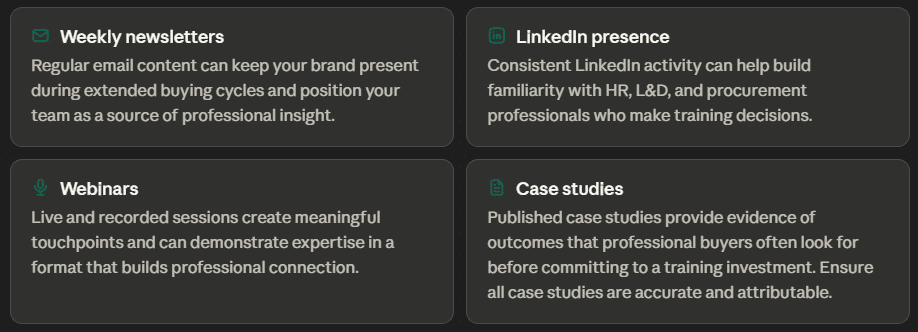
3. Your brand lacks consistent professional visibility
In competitive professional markets, buyer confidence tends to develop over time rather than through a single touchpoint. Prospective clients may research providers across weeks or months before making a decision, and during that period, the brands they encounter most consistently may gain a familiarity advantage.
4. You’re not sharing proof of independent recognition
Publicly sharing milestones such as new accreditations, client project completions, and learner achievements can help reinforce your market position. This is sometimes described as social proof, evidence that others have engaged with and benefited from your offer.
Milestones worth sharing
- New CPD accreditation achievements or renewals
- Client project completions, with client consent and accurate representation
- New programme launches with accurate descriptions of content and outcomes
- Learner success stories: genuine, attributable, and not exaggerated
5. Buyers can’t find independent validation during their online research

As AI-assisted search tools become more commonly used for professional research, content that is contextually rich, professionally authoritative, and associated with recognised organisations tends to be surfaced more readily. CPD accreditation, as an independently assessed quality standard, may contribute positively to how your training programmes are described and retrieved in AI-generated search responses.
6. Your offer lacks formal recognition in procurement and tender processes
In formal procurement contexts, particularly in larger organisations, the public sector, and regulated industries. Buyers often evaluate training providers against explicit quality criteria.
CPD accreditation can provide a recognised framework of quality assurance that supports these evaluations.
Does CPD accreditation help with winning tenders and procurement?
CPD accreditation provides independently assessed quality recognition that is relevant in many formal procurement and tender processes. It may support your submission by demonstrating that your training meets an established professional standard. Outcomes will depend on the specific procurement criteria set by individual organisations.
7. You haven’t yet explored how accreditation could support your growth
CPD accreditation is sometimes treated primarily as a quality mark for learners. Its commercial relevance to training providers, in supporting buyer confidence, strengthening positioning, and providing independent recognition, is often less fully explored.
Join us at the CPD Networking Day in London | 10 June 2026 | 2pm – 5pm
FAQs:
1. What does CPD training mean?
CPD training stands for Continuing Professional Development training, a structured approach to learning that helps professionals maintain and enhance their skills throughout their career. Unlike one-off qualifications, CPD training is ongoing and relevant to your current role and industry.
Learn more about what CPD training means →
2. Is cpd certification legit?
Yes, when awarded by a recognised body, CPD certification is a credible and respected mark of quality.
The CPD Standards Office is one of the UK’s independent CPD accreditation organisations, ensuring that certified training meets rigorous professional standards.
Find out how our CPD accreditation works →
3. Who needs CPD certification?
CPD certification is valuable for any professional in a regulated or knowledge-driven industry: including healthcare, education, finance, law, and HR. For training providers, CPD accreditation signals to employers and learners that your programmes meet independently verified standards.
See who benefits from CPD certification →
4. What is the role of AI in Continuing Professional Development?
The CPD Standards Office recognises that AI is rapidly transforming how CPD training is created and delivered. Training activities developed using AI can be efficient, engaging, and tailored to individual learner needs, incorporating machine learning, natural language processing, and predictive analytics. CPDSO closely monitors AI’s influence on CPD standards from both the learner and provider perspective, ensuring that rigorous quality benchmarks are maintained as AI continues to shape the future of professional development.